
Key takeaways
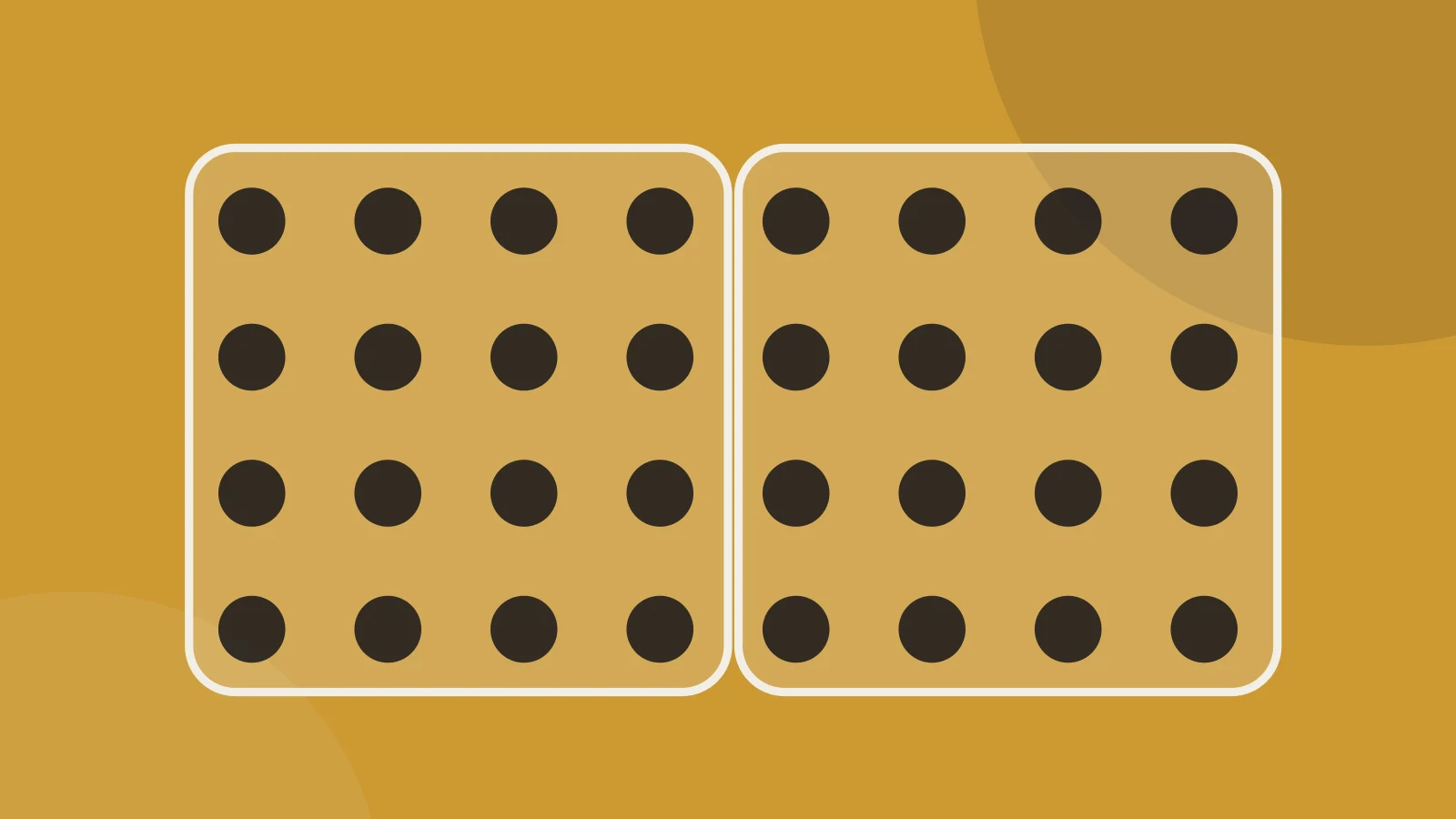
Lines, frames and shared colours that link elements make them one group.
A visible connection can outweigh other cues, such as proximity or similarity.
Origins
The principle was proposed in 1994 by the psychologists Stephen Palmer and Irvin Rock as a Gestalt grouping law of its own. Their experiments showed that items joined by a line or sharing a background are perceived as a single unit, and that the effect beats proximity and similarity when the cues conflict.
In practice
- Connect the steps of a process with a line, as in a stepper or a timeline.
- Show the link between a control and what it changes, for example with a shared background.
- Use connection sparingly: join only what really belongs together.
Further reading
- Gestalt Principles of Perception — Andy Rutledge
- Laws of Proximity, Uniform Connectedness, and Continuation — Interaction Design Foundation | Mads Soegaard
- Design Principles: Visual Perception And The Principles Of Gestalt — Steven Bradley | Smashing Magazine
- Law of Uniform Connectedness on Laws of UX — Jon Yablonski
The illustration is our own, drawn after the idea of this law’s card in Laws of UX by Jon Yablonski.