
Key takeaways
Spacing alone can group content, with no lines or boxes.
Put related things close and unrelated things far apart, so that a screen can be scanned in clusters.
Origins
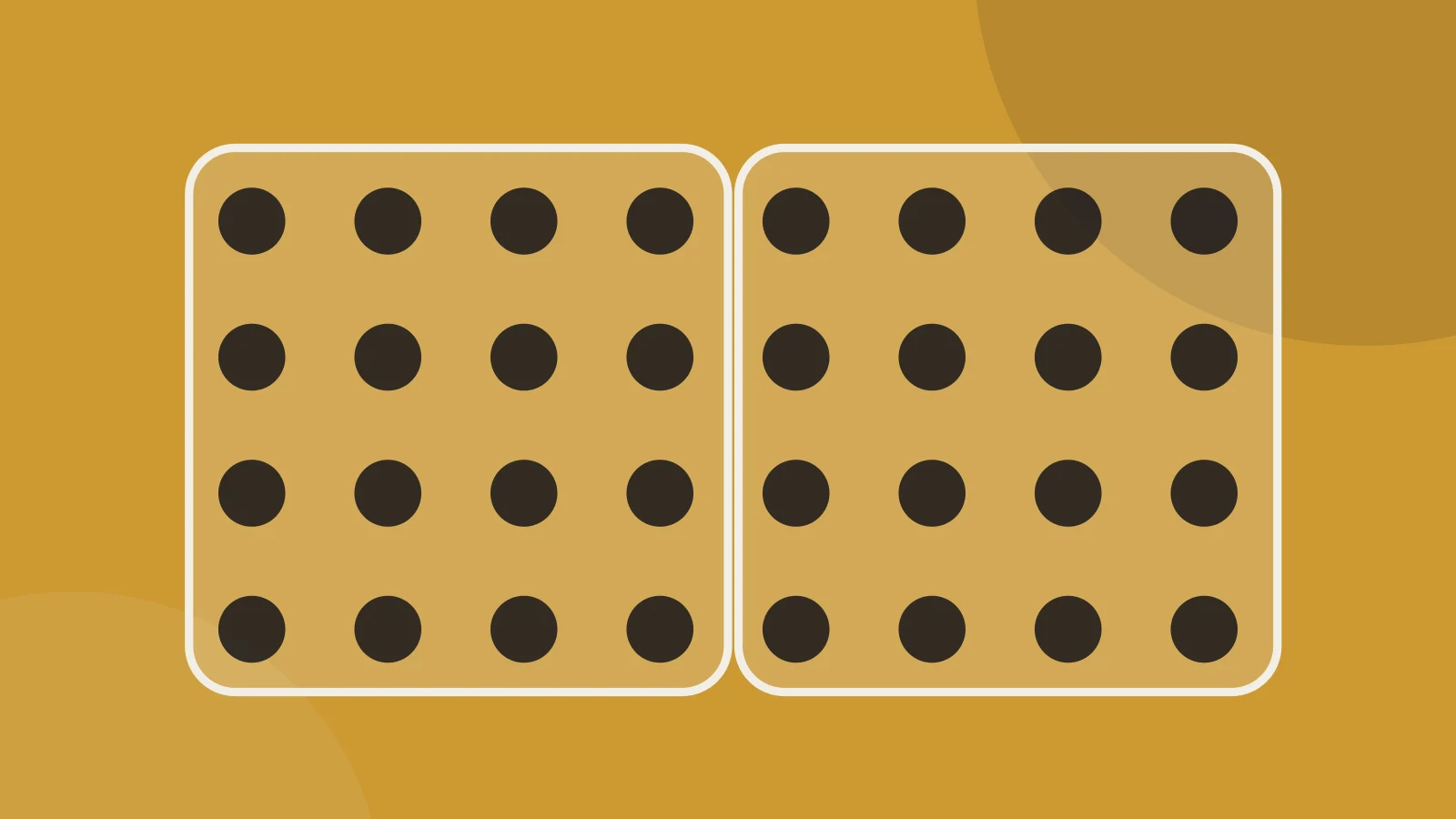
Proximity is one of the Gestalt laws of grouping, set out by the German psychologists Max Wertheimer, Kurt Koffka and Wolfgang Köhler in the early twentieth century. They described the mind’s tendency to see patterns and groups before individual parts: items that are nearer to one another are read as a set, even when they differ in colour or shape.
In practice
- Keep a label closer to its own field than to the one above it.
- Use whitespace rather than rules to separate sections.
- In a set of cards, make the gap between groups clearly larger than the gap inside one.
Further reading
- Laws of Proximity, Uniform Connectedness, and Continuation — Mads Soegaard | Interation Design Foundation
- The Psychology Principles Every UI/UX Designer Needs to Know — Thanasis Rigopoulos | Marvel
- Design Principles: Visual Perception And The Principles Of Gestalt — Steven Bradley | Smashing Magazine
- Law of Proximity on Laws of UX — Jon Yablonski
The illustration is our own, drawn after the idea of this law’s card in Laws of UX by Jon Yablonski.