
Key takeaways
The number of choices is directly linked to the time it takes to decide.
Simplify choices and complex processes by breaking them into parts, showing fewer options at a time.
Don’t add confusion with labels such as “recommended option” beyond what is needed.
Origins
Hick’s Law, also called the Hick–Hyman Law, is named after the British psychologist William Edmund Hick and the American psychologist Ray Hyman. In the early 1950s (Hick in 1952, Hyman in 1953) the two set out to relate the number of stimuli to the time it took people to respond, and showed, as expected, that the more items there are to interact with, the longer it takes to choose one. The relation is logarithmic: doubling the options adds a constant amount of time. Overwhelming users with options is as tiring and off-putting as making them do something they didn’t want to.
Further reading
- Hick’s Law: Making the choice easier for users — Mads Soegaard | Interaction Design Foundation
- Hick’s Law — Quick Decision Making — Anton Nikolov | Medium.com
- The Psychology Principles Every UI/UX Designer Needs to Know — Thanasis Rigopoulos | Marvel
- Hick’s Law on Wikipedia — Wikipedia
- Hick’s Law on Laws of UX — Jon Yablonski
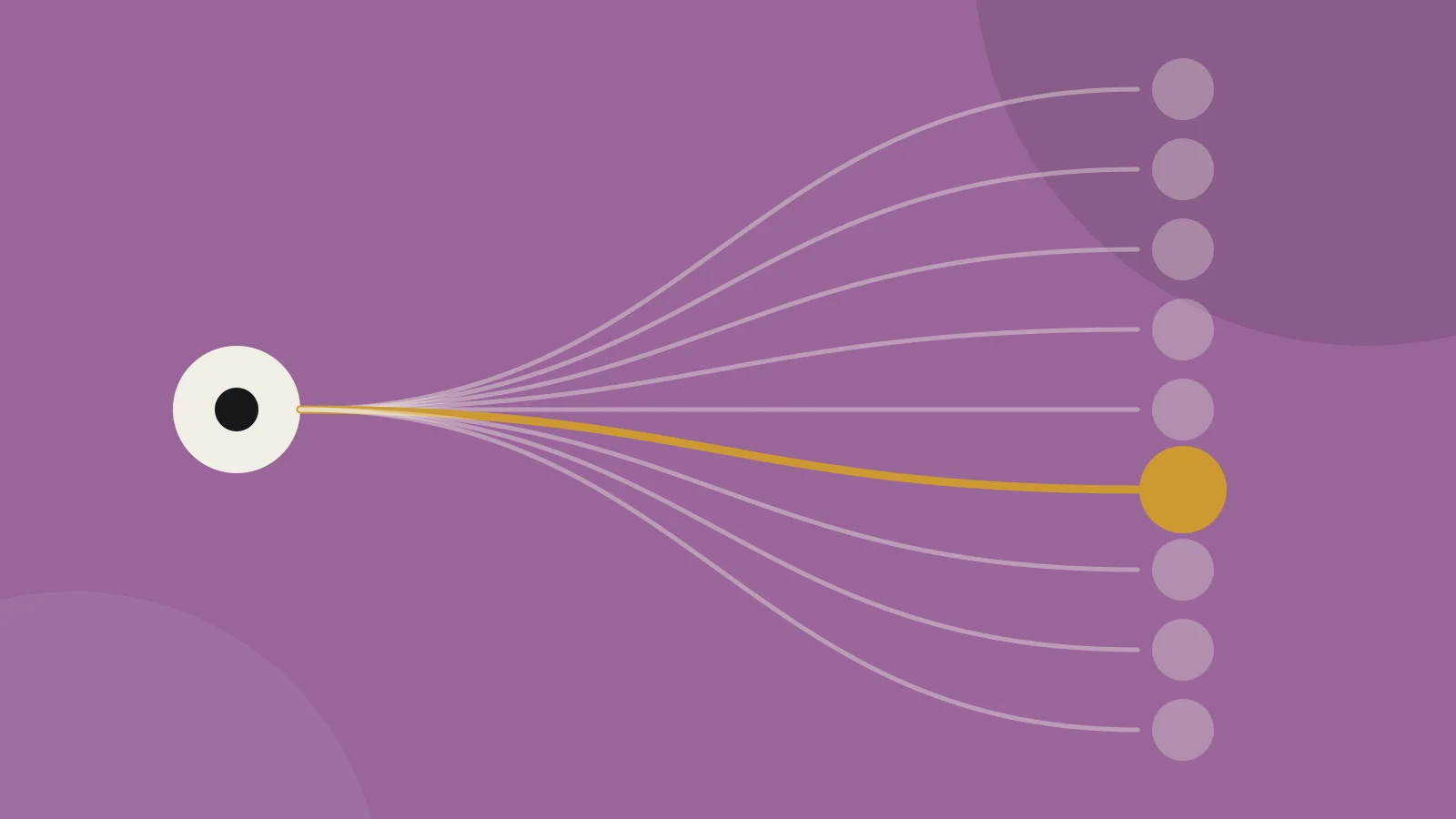
The illustration is our own, drawn after the idea of this law’s card in Laws of UX by Jon Yablonski.